Symbolic pics: Lady Gaga, Marina and the Diamonds and a whole lot of blatant MK imagery in fashion photoshoots.
This
photoshoot entitled “Sweet Escape” is featured in the October issue of W
magazine and was shot by Nick Knight – the director Lady Gaga’s video
“Born This Way” (analyzed on this site). The photoshoot is replete with
Mind Control imagery, complete with references to trauma and alter
personas. The title “Sweet Escape” references the concept of
dissociation. In this image, the otherwordly model appears to be lifting
up while reading a fairytale (which are used to programmed MK slaves).
In
this pic, the model is holding a cage with a bird trapped in it, a
classic symbol representing mind control. To make things more obvious,
one of the birds is hiding one of the model’s eyes while the other is
shown bleeding.
In
this pic, the model is “in the clouds” (dissociation) and there’s
another emphasis on a single eye. She has red scars on her arms and
legs, symbolizing the trauma and abuse of Mind Control.
The
model’s alter persona lies dormant in a stroller while the active
persona is awake. She wears rabbit ears, symbol of mind control (as in
follow the white rabbit towards dissociation).
The
reflection in the mirror is “independent” from the model, symbolizing
the existence of a separate alter persona that is “behind the looking
glass”. Scars on the chair still represent trauma.
Discarted/unused
alter personas laying lifeless on a dead tree. They are “silenced” by
butterflies on their mouth – representing Monarch programming. This
entire photoshoot truly contains almost every symbol associated with
mind control.
The
final images of the photoshoot are a lot darker, as if representing the
final product of the MK slave. In this image, a “black wedding” with
the dark side…the model doesn’t seem to happy about it.
Final image of the shoot: An emotion-less model in a very dark setting with one eye hidden. Transformation complete?
Isabela Fontana in Allure magazine with a mega-emphasis on the one-eye symbol.
Another pic from Fontana’s photoshoot with a collar, symbolizing control and dehumanization.
Lady
Gaga “tributing” Michael Jackson during a London fashion week. That’s
great, but why is she wearing big-ass Mickey Mouse ears (a symbol of
mind control)? Is she ridiculing the fact that MJ was a victim of the MK
music industry?
During
the same fashion show, Gaga wore another outfit. But let’s try to
ignore that flowery thing she has on her face and let’s look at the guy
next to her: hat designer Philip Treacy. His t-shirt is also referring
to Michael Jackson in an odd way, with a one-eyed charicatural version
of him. Why does it seem like people in the industry ridicule MJ’s
death? How about stopping these questionable “tributes” and let him
rest in peace? In case you’re wondering about Philip Treacy’s
connections with the Mind Control entertainment industry, let’s look at
some of his most famous hat designs:
I don’t think there’s a more blatant way to describe Monarch Mind Control.
Yup, that’s how he does it.
Creepy-ass
Terry Richardson with Lady Gaga, who is wearing a sex-kitten outfit.
Wait, maybe this has nothing to do with sex-kitten programming and she
only likes the pattern…
Nope, sex-kitten.
Popular
Welsh singer Marina and the Diamonds is all about that Illuminati
one-eyed symbolism. Here she is on the cover of Factory magazine.
Just, you know, like, casually hiding one eye and stuff.
Again.
Like all young female industry pawns, Marina poses as a blond Marylin Monroe, the prototype of industry-controlled sex-kittens.
So this hair color is “6.66 Babylon”? That’s a pretty hardcore hair color name…
Speaking
of the number of the beast, here’s a new design from Lil Wayne’s
favorite clothing line, UNIF. Three 6′s holding hands…how cute!
Macedonian ad for mobile phone company… And, for no apparent reason, a model hiding one eye.
Homepage of the official website of Stitches…For no apparent reason, a model hiding one eye.
Laundry
Day Festival in Belgium…a bunch of young people dancing under a
gigantic stage full of Illuminati symbolism disguised as a theme of
pseudo-esoteric-enlightenement.
Irrational Consumerism (or The Few Companies Who Feed the World)
Not many people realize that most of the processed foods available on the market, whether they be in groceries or fast-food chains, all come from the same few companies. Even less people realize that these companies are major actors in elite organizations who decide health, social and economic policies around the world. We’ll look at the big three companies who feed the world, their many brands and the tactics they undertake to make people crave their products.
If one were to carefully study the labels on packaged products in an average grocery store, one would probably notice that the same company names appear repeatedly: Nestlé, Kraft, General Mills and a few others. Many brands offering good ol’ fashioned homemade or all-natural/organic foods are nothing more than subsidiaries of these few world-wide mega-companies. The major difference between the main brand and the subsidiaries is packaging and advertising, which are targeted to reach different markets. In order to preserve the carefully crafted image surrounding a product, connections to the mother company are often conveniently hidden. Imagine an advertisement for bottled water going like this: “Drink pure, clear, refreshing Aquafina water, bottled with care from remote natural sources in the Himalayas … BROUGHT TO YOU BY PEPSICO, THE MAKER OF TACO BELL AND CHEETOS MIGHTY ZINGERS!” That would probably spoil the healthy, natural image they are trying to create for the product. That is the reason marketing and branding are the most vital part of the food industry. Each product must live in its own “world”, separate from its mother company and similar products. Advertising is so powerful that two similar brands of cereal, made from the same basic ingredients, can be targeted to entirely different markets. For example, are Special K and Rice Krispies so different? From a strictly rational viewpoint, these products are nearly identical in shape, taste and ingredients. From an irrational (marketing) viewpoint however, they are in two different worlds. Advertisements for Rice Krispies revolve around colorful cartoon characters and played during Saturday morning kids’ shows while Special K tends to show fit women doing yoga (or on their way to or from yoga). Rice Krispies boxes have games and toy giveaways, while Special K‘s box gives access to a “weight loss challenge” website. All of this is smoke and mirrors, however, because at the end of the line, whether you choose one, the other or pretty much any other cereal in the grocery store, you’re eating the same thing and your money ends up at the same place. The processed-food industry can be considered a true oligopoly. Together, the three leading food companies, Nestle, Kraft Foods and PepsiCo, achieve a dominant proportion of global processed-food sales. In fact, these three companies are often used as an example of “Rule of Three” in business schools, since they are a real-life example of a market being dominated by three gigantic actors. Their position as worldwide food providers has made these conglomerates extremely powerful, and they are represented in most elite organizations such as the Council of Foreign Relations. This not only allows them to provide their preferred policies on nutrition and health issues across the globe, but on economic, political and social issues as well. Such prominence also allows these companies to ensure their continued market dominance, through policy-making, access to insider information and the intimidation of potential competitors. If considered objectively, the oligopoly of major companies like these are a direct threat to free market theories. Today, if a small food company were to create a new revolutionary product, it would find it difficult to obtain distribution without giving up its rights to one these conglomerates. In addition to dominating the shelves, the Big Three control most of the worldwide channels of distribution, to the point that up-and-coming companies cannot reach the consumers without dealing with them. The only way small business owners can avoid years of struggle and rejection to obtain shelf-space in supermarkets is to strike a licensing deal with one of the giants, where the owner cedes the ownership and the rights to the product in exchange for royalty checks (which are usually a small percentage of the sales). Each licensing deal consolidates these companies’ position and eliminates threats from any potential competitor who creates game-changing products. Here are the top three companies and a summary list of their multiple brands:
1- Nestlé
Nestlé is the world’s largest food company. It has 6,000 brands, with a wide range of products across a number of markets including coffee, bottled water and other beverages, chocolate, ice cream, infant foods, performance and healthcare nutrition, seasonings, frozen and refrigerated foods, confectioneries and pet food. In 2009, consolidated sales were close to $120 billion USD and investments in research and development were $2.24 billion USD. The chairman of the company, Mr. Brabeck-Letmathe, is on the Board of Directors of Credit Suisse Group, L’Oréal and ExxonMobil. He is also a member of ERT (European Round Table of Industrialists) and a member of the Foundation Board of the World Economic Forum (an important actor in the push for a world government). Products sold by Nestlé include:
Cereals
Cinnamon Toast Crunch
Cheerios (outside US, Canada and Australia)
Cini Minis
Honey Nut Cheerios (outside US, Canada and Australia)
Oat Cheerios
Cookie Crisp
Golden Grahams
Honey Stars
Koko Krunch
Milo Cereals
Nestlé Corn Flakes
Nesquik
Shreddies
Shredded Wheat
Clusters
Trix
Aberfoyle
Aqua D’Or
Aqua Pod
Acqua Panna
Al Manhal
Aquapod
Arrowhead
Buxton
Contrex
Deer Park
Hépar
Ice Mountain
Henniez
Korpi
Levissima
Nestlé Aquarel
Nestlé Vera
Ozarka
Perrier
Poland Spring
Powwow
Minere
Pure Life/Pureza Vital
Quézac
San Pellegrino
San Bernardo
Viladrau
Vittel
Zephyrhills
Other drinks
Nestea (Joint venture with Coca-Cola, Beverage Partners Worldwide)
Enviga (Joint venture with Coca-Cola, Beverage Partners Worldwide)
Milo
Carnation
Caro
Nesquik
Libby’s
Growers Direct Organic Fruit Juices
Good Host
Juicy Juice
Ski up and go
Camy
Dreyer’s
Edy’s
Frisco
Häagen-Dazs (North America and the United Kingdom)
Hjem-IS (Denmark & Norway)
Maxibon
Motta
Mivvi
Nestlé
Nestlé Drumstick
Oreo (Canada)
Peters (Australia)
Push-Up
Schöller
Skinny Cow
Infant foods
Alete
Alfare
Beba
Cérélac
FM 85
Gerber (the world’s largest baby food company)
Good Start
Guigoz
Lactogen
Nan
NAN HA
NanSoy
Neslac
Nestlé
Nestogen
Nido
PreNan
Stouffer’s
Lean Cuisine
Buitoni
Hot Pockets
Lean Pockets
Papa Guiseppi
Tombstone Pizza
Jack’s Pizza
DiGiorno Pizza
California Pizza Kitchen Frozen
Chocolate, confectioneries and baked goods
100 Grand Bar
Aero
After Eight
Allens
Animal Bar
Baby Ruth
Bertie Beetle (Australia)
Big Turk (Canada)
Black Magic
Boci (Hungary)
Blue Riband
Bono(Brazil)
Breakaway
Butterfinger
Butterfinger BB’s
Butterfinger Crisp
Bon Pari (Czech Republic, Poland and Hungary)
Cailler
Caramac
Carlos V
Chips Ahoy! (Canada)
Coffee Crisp
Chunky
Drifter
Frigor
Galak/Milkybar
Goobers
Heaven
Hercules Bars (with Disney)
Icebreakers
Kit Kat (Hershey’s in the US)
Lion
Matchmakers
Milky Bar
Mirage
Joff
Munchies
Nestlé Alpine White
Nestlé with Almonds
Nestlé Crunch
Nestlé Crunch Crisp
Nestlé Crunch with Caramel
Nestlé Crunch with Peanuts
Nestlé Crunch Pieces
Nestlé Crunch White
Nestlé Milk Chocolate
Nestlé Princessa
Nestlé Wonder Ball
Nips
Nuts (Europe)
Oh Henry (except US)
Peppermint Crisp
Perugina Baci
Polo
Quality Street
Raisinets
Rolo (Hershey’s in the US)
Rowntrees
Fruit Pastilles
Jelly Tots
Pick & Mix
Randoms
Fruit Gums
Tooty Frooties
Juicy Jellies
Snowcaps
Smarties
Texan Bar
Toffee Crisp
Toll House cookies
Turtles
Walnut Whip
Violet Crumble
Yorkie
XXX mints
Petcare
Alpo
Beneful
Cat Chow
Dog Chow
Fancy Feast
Felix
Friskies
Go Cat
Butchers
Bakers
Winalot
Gourmet
Mighty Dog
Mon Petit
ONE
Pro Plan
Purina
Tidy Cats
Controversy
Nestlé has faced ongoing resistance around the world for its promotion of breast milk substitutes (infant formula), especially in third world countries. According to campaigners, Nestlé contributes to the unnecessary suffering and even deaths of babies, largely among the poor.
Advocacy groups and charities have accused Nestlé of unethical methods of promoting infant formula over breast milk to poor mothers in developing countries. For example, IBFAN claim that Nestlé distributes free formula samples to hospitals and maternity wards; after leaving the hospital, the formula is no longer free, but because the supplementation has interfered with lactation, the family must continue to buy the formula. IBFAN also allege that Nestlé uses “humanitarian aid” to create markets, does not label its products in a language appropriate to the countries where they are sold, and offers gifts and sponsorship to influence health workers to promote its products.Nestlé denies these allegations. - Source
2- Kraft Foods
A subsidiary of Philip Morris (the maker of Marlboro cigarettes). Kraft Foods is the largest confectionery, food, and beverage corporation headquartered in the United States. It markets many brands in more than 155 countries; eleven of its worldwide brands each earn more than $1 billion annually. Like Nestle, Kraft has consolidated its status in the food oligarchy by buying gigantic brands such as Nabisco (Oreos, Chips Ahoy, Fig Newtons, Ritz, etc.) and Cadbury (Ferrero Rocher, Dairy Milk, Caramilk, etc.).
If we add it up, how many hours have we spent mesmerized by swirling chocolate on TV?
Kraft’s CEO Irene Blecker Rosenfeld was rated the “2nd most powerful woman in the world” by Forbes. Not surprising since most of the world consumes Kraft foods. Before joining Kraft, Rosenfeld was Chairman and Chief Executive Officer of Frito-Lay, a division of PepsiCo (another of the “Big Three”). Kraft’s brands include:
Toblerone chocolate bars
A1 Steak Sauce
Ali Coffee
Arrowroot biscuits
Back to Nature
Baker’s (chocolate)
Balance Bar
Better Cheddars
Boca Burger
Bonox
Breakstone’s
BullsEye Barbecue Sauce
Café HAG
California Pizza Kitchen (grocery store items)
Calumet Baking Powder
Cameo (biscuits)
Capri Sun (juice drink)
Carte Noire
Cheesybite
Cheese Nips
Cheez Whiz
Chicken in a Biskit
Chips Ahoy! (cookies)
Christie (Canadian division of Nabisco)
Claussen (pickles)
Clight
Club Social (crackers)
Cool Whip (non-dairy whipped cream)
CornNuts (snack food)
Côte d’Or (Belgium)
Country Time (powdered drink mix)
Cracker Barrel
Crystal Light
Dairylea (Europe)
Delissio (Canada)
DiGiorno (pizza)
Easy Cheese
Fig Newtons
Fudgee-O (Canada)
General Foods International
Grape-Nuts (breakfast cereal)
Grey Poupon (mustard)
Nabisco
Nabob (coffee) (Canada)
Naked Drinks
Nilla
Nutter Butter
Onko (coffee)
Oreo (cookie)
Oscar Mayer
Grated Parmesan cheese
Philadelphia cream cheese
Pigrolac
Planters
Polly-O (cheese)
Premium (a Nabisco brand of saltine crackers)
Pretzels
P’tit Québec
Prince Polo
Pure Kraft Salad Dressings
Ritz
Royal baking powder
Seven Seas (salad dressings)
Sanka (decaffeinated coffee)
Shake ‘n Bake
Simmenthal (canned meat)
Snackabouts
SnackWells
South Beach Living
Starbucks (grocery store items)
Stove Top stuffing
Suchard
Taco Bell (grocery store items)
Tang
Tassimo (single-serve coffee machines using pods branded as T-Discs)
PepsiCo
PepsiCo Incorporated is a global Fortune 500 corporation headquartered in Purchase, Harrison, New York, with interests in the manufacturing, marketing and distribution of beverages, grain-based snack foods and other products. If you hadn’t guessed it, its main product is Pepsi Cola, but soda pop is not the company’s only product. In fact, a teenager with the munchies could easily leave a convenience store with three or four PepsiCo products without realizing it (or caring). PepsiCo is a “Premium” member of the Council of Foreign Relation and of the Brookings institute, two of the most important organizations for the world’s elite (as seen in the article Naming Names: Your Real Government). The chairman and CEO of PepsiCo, Indra Nooyi, is part of the World Economic Forum. Within these organizations, executives from PepsiCo and other mega-corporations like Sony (the largest label in the music industry), Nike (the largest shoe seller in the world), Rockefeller Group International, and Lockheed Martin (the largest defense company in the world), work alongside various heads of state (including past US presidents), policy-makers (such as current US Secretary of State Hilary Rodham Clinton) and image makers (like Tom Brokaw and George Clooney), to develop political, social and economic opinions and recommendations affecting entire countries. The policies favored by these organizations are collectively steering the world towards a unified world government and a single world currency, in what is often referred as a “New World Order”. PepsiCo brands include:
Drinks:
AMP
Brisk
Mountain Dew
Ocean Spray
Mist
Aquafina
Lipton Ice Tea
MUG
Pepsi
Sobe
Gatorade
Tropicana
No Fear Energy Drink
Propel Enhanced Water
Starbucks (retail products)
Food
Lay’s
Doritos
Tostitos
Cheetos
Fritos
Sun Chips
Baked!
Frito Lay Dips
Baken-Ets
Chester’s Puffcorn
Cracker Jack
El Isleno Plantain Chips
Frti-Lay Peanuts
Funyuns
Gamesa
Grandma’s
Matador
Maui Style Potato Chips
Miss Vickie’s
Munchies
Munchos
Natural
Nut Harvest
Quaker
Rold Gold
Ruffles
Sabritones
Santitas
Smartfood
Spitz
Stacy’s
Yep, even the good ol’ trustworthy Quaker guy is part of PepsiCo.
The Spin-Off Company
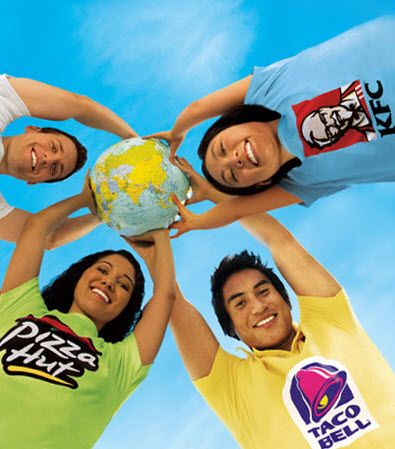
PepsiCo also feeds millions daily through its spin-off company, Yum!, which owns restaurant chains including Pizza Hut, Taco Bell, KFC,Hot ‘n Now,East Side Mario’s,D’Angelo Sandwich Shops,Chevys Fresh Mex, California Pizza Kitchen and Stolichnaya.
An odd picture from Yum!‘s official website.
Many of the products listed above have existed for decades, some for over a century. What is the secret of such enduring success? First, the recipe has to be just right. As mentioned above, Nestlé spent more than $2 billion dollars in 2009 alone for research and development, which is mostly used to pay people in lab coats to create the most appealing, taste-bud satisfying, addicting and, of course, cost-effective products possible. The addictive properties of salt, fat, sugar and other chemicals are well known to the $2 billion-per-year researchers. Processed foods contain a carefully calculated mix of chemicals and additives that send “satisfying” signals to the brain, which the brain then continues to seek out in the form of cravings. However, there are countless companies selling similar products. So in order to keep consumers coming back to their specific brand, corporations invest billions of dollars in the second secret of success: “brand loyalty” achieved through marketing and advertising.
Irrational Advertisement
While the ultimate goal of an advertisement is to sell a product, PR firms will tell you that they are seeking to go way beyond the cheap sell. Their mission is to create an emotional attachment to a product, a concept that is totally irrational, yet extremely effective. They don’t just want you to like their product, they want you to identify with it. They want you to define yourself by it. They are looking to create loyal, life-long customers by creating an image, a lifestyle and even a philosophy around a product. Let’s take this Miracle Whip commercial as an example.
By showing people partying and running on the beach, the advertisement attempts to create an association between the product and being young, cool, hip and rebellious. Although the ad is a bit heavy handed, I do agree that there’s nothing more rebellious than stuffing one’s face with a sandwich full of mayonnaise substitute. Rock on. Advertisements like these are meticulously calculated to reach a particular demographic population and to generate specific emotions within these viewers. To achieve these aims, they rely on extensive research on human behavior.
“No group of sociologists can approximate the ad teams in the gathering and processing of exploitable social data. The ad teams have billions to spend annually on research and testing of reactions, and their products are magnificent accumulations of material about the shared experience and feelings of the entire community.”
- Marshal McLuhan, The Extensions of Man
To sell brand loyalty to a viewer through a television advertisement, rational/logical arguments have limited effects. The most effective and successful ads are able to bypass rational thought (where an argument can either be accepted or rejected) and tap directly into the viewer’s subconscious, through their instincts, fears or insecurities.
“It is with knowledge of the human being, his tendencies, his desires, his needs, his psychic mechanisms, his automatisms as well as knowledge of social psychology and analytical psychology that propaganda refines its techniques.”
– Propagandes, Jacques Ellul (free translation)
To illustrate this, let’s look at two typical food advertisements aimed at an important market: mothers.
Irrational Advertisement: Selling to Mothers
For marketers, mothers are a dream. They have an enormous weak spot: children, especially their own. This love for kids is not rational: the maternal instinct is one of humanity’s most primal and hormonal reflexes. To tap into it is to directly tap into a mother’s internal hard-wiring. Through the use of research and focus groups, advertisers have learned the most effective ways to get reactions out of mothers, and create targeted ads that make mother’s feel worried, moved, scared, angry or unsettled. Once the target is in the intended emotional state, the product is presented as the answer to everything. Here’s a flour advertisement specifically directed at mothers:
So this advertisement sells flour. A big ol’ bag of white powder. If it was rational, it would had described the flour’s above-average performance (which is true) or perhaps its advantageous cost per pound. It doesn’t. It goes straight to the emotions. To effectively reach its audience, the ad does not talk about flour at all, but about loving one’s children and “baking memories”. Behind the cutesy, heart-warming feel, the truth is that the ad taps into mother’s visceral fear of being considered “a bad parent”. To do so, the marketers have conceived a cleverly phrased, psychologically manipulative speech given by a cute animated girl that sends non-baking mothers into a mega-guilt trip. The ads is basically says this:
“By refusing to bake muffins for your children, you are robbing them of happy, licking-batter-off-a-spoon memories. And since memories are all we have in life, you are robbing them of THEIR LIVES. How can you do this to them? Do you want your children to become broken and empty individuals? Do you? No? Well, stop being such an incompetent mother and buy that bag of flour and make some muffins. Maybe then your children will remember you as a ‘Good Mother’. Maybe. If it’s not too late. You might have messed everything up already with your outrageous non-baking ways. Shame!” Here’s another advertisement aimed at mothers. Did you cringe a little watching this? Nothing about it makes sense. Good thing rationality is not necessary to sell things. First, let’s point out the obvious: If this happened in real life, most college students would be PISSED. This would be a more realistic conversation: “Hi mom. I got your package …Why did you send me peanut butter? I don’t get it … You’re aware that I can buy peanut butter out here, right? So why did you send this? Do you know what Jenny’s parents sent her? Three hundred bucks. What do I get? A G*D DA*MN JAR OF PEANUT BUTTER?!” Okay, but seriously, as stated above, marketers bypass rational arguments where one would consider peanut butter to be a jar of crushed peanuts. In the world of marketing, peanut butter needs to be more than peanut butter. Through its advertisement, Jif is no longer a mass-produced jar of low-grade peanuts and sugar, but a symbol of maternal warmth in an otherwise cold, cruel world. Advertising replaces ignorance or indifference toward a product with a bunch of mushy feelings that have nothing to do with peanut butter. And in case you didn’t get the message, the ad goes ahead and spells it out for you, too: “It is more than just that great peanut taste, choosing Jif is a great way to show someone how much you care”.
In Conclusion
Why should one care about which company sells which product? Primarily, it is a question of health. Almost all of the hundreds of products cited in this article contain toxic ingredients, from excessive amounts of saturated fat to additives like MSG, High Fructose Corn Syrup (HFCS), mercury and/or aspartame. These substances, and many more like them, are poisonous to the body, the nervous system and the brain (as discussed in the article Dumbing Down Society: Food, Beverages and Meds). Processed foods are making the entire world fatter, sicker and dumber, even though only a few companies produce them. It is vital to know and recognize them … so you can avoid them. It is also important to recognize the basic marketing tactics that are being used to push consumers to buy processed foods. The issue is much larger than individual health, however.To be aware of the companies selling your food is to be aware of important actors of the world elite. As the saying goes “control the food and you control the people”. If you believe it is important to know the truth about the world’s power structure, it is fundamental to know about these companies and understand their extensive reach throughout all areas of our global society. They might “only” sell food, but their power and position gives these conglomerates an active role in world governance, including economy, politics, law-making and even the military (who do you think supplies military mess halls?). The Big Three and globally dominant corporations like them are part of policy-setting “think tank” organizations such as the Council on Foreign Relations and the Bilderberg Group, which serve as the true motors behind global change. Should PepsiCo have a say in the invasion of a country such as Iran? Well, it does. And every time you buy a Pepsi or a bag of Doritos or jug of Tropicana, you are helping them become richer and more powerful. Luckily, however, there is an easy way to stop supporting these companies: Simply replace the processed products you buy from these companies with fresh foods bought from local businesses. You’ll improve your health and your local economy, but most importantly, you’ll also become the elite’s worst nightmare: a rational consumer.
Brown Eyed Girls’ Video “Sixth Sense” or How the Elite Controls Opposition
Backed by big money and millions of fans, the Korean pop music
industry (K-Pop) has taken over the airwaves of Asia and the world.
Although groups such as Brown Eyed Girls do not sing in English, they
definitely bring to the masses the same Illuminati symbolism pushed by
pop stars in the Western world. The video of “Sixth Sense” is a true
manifesto of the elite, describing how it controls entertainers and uses
them to indoctrinate the masses. This article analyzes the meaning of
the symbolism in Brown Eyed Girls’ music video “Sixth Sense”.
In last year’s article Narsha and SHINee: Illuminati Infiltration of K-Pop,
I looked into the symbolism of two popular K-Pop videos and how they
fit in the global Illuminati agenda. Since then, Korean pop has only
gotten bigger as record labels like NegaNetwork and SM Entertainment
churn out new boy and girl bands at a hectic pace. These labels are
almost “pop music sweatshops” as scandals have arisen regarding the
mistreatment of K-Pop stars and the signing of “slave contracts”. These
labels are, in turn, owned and controlled by the same elite global media
corporation who own American and British labels and pop stars. In this
context, is it surprising that K-Pop videos show its stars tied down and
submitting to a totalitarian power? The video of Sixth Sense from the very popular girl band
Brown Eyed Girls, could not better portray the elite’s control on media
and entertainment. More than simply displaying Illuminati symbolism,
the video presents the blueprint of how popular figures can be used to
communicate a specific message using sex and music as an incentive. Each
one of the group’s members are shown in a different position of
submission, each representing the different ways the elite controls
entertainers to serve its interests. While Myrio, Narsha, Ga-In and Jea
appear to be rebelling against an authoritative police state, they are,
at the end of the day, controlled opposition, serving in the elite’s
Hegelian dialectic. Yes, all of these complex concepts are found in a
K-Pop video intended for children and teenagers. Are they being warned
or indoctrinated by the message of the video? Let’s look at the
symbolism of the video and the messages it communicates to the viewers.
The Premise of Sixth Sense
The video takes place in the context of a totalitarian police state,
where media is tightly controlled and people are tightly monitored.
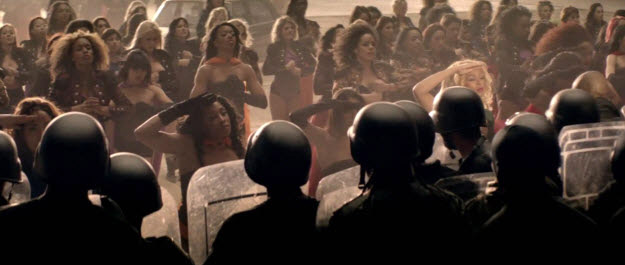
The video begins showing police in riot gear and video cameras, setting it in a Big-Brotherish police state.
The regime is
controlled by a masked figured named “the Absolute” (according to an
interview with the lyricist of the group), who could easily be
associated with the “masked” occult elite.
The
Absolute looking over its army of riot police. Yet another music video
getting young people used to the idea of an oppressive police state.
There appears to be some resistance to the Absolute’s regime, namely
Brown Eyed Girls. They are shown standing in defiance of the riot police
and appear to be taking a stance against the oppression of the
Absolute. As an ultimate gesture of defiance, the group starts singing.
Do they sing about freedom and liberation? Are they singing out what is
on everyone’s mind? No, not really. The listeners are treated to the
same pseudo-sexual drivel all pop songs numbs our brains with. Here’s a
translation of the first verse:
Your thirsty face starts sweating
And your flesh is on the tip of my sharp fingers The bubble in champagne
Explodes, good pain
No need to worry, love is just a game
What does this have to do with resistance? Not much. In fact, the
song is about the exact opposite: Not resisting but giving in to the
“Sixth Sense”. Are B.E.G. truly in opposition to the riot police or are
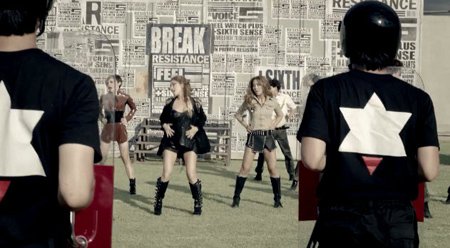
they in fact on their side? The six-pointed star on the police uniforms
represent the “Sixth Sense” so it would seem both sides are about the
same thing.
The
riot police wears a star with its lowest point red, symbolizing the
sixth sense. In occult symbolism, upside down triangles represents the
vulva, the feminine energy and reproduction.
What exactly is the “Sixth Sense”? Judging by the lyrics of the song
and the symbolism of the video, it is sexual energy – the most basic and
primal of human instincts. It is the easiest way to capture and keep
the attention of an audience and is used ad-nauseam in pop music to
generate interest in otherwise insipid songs. Pretty girls can make
things such as a fascist police-state cool. On an esoteric level,
reproductive organs are part of the base chakra, which can explain why
it is associated in the video with the lowest point of the sixth-pointed
star. While the five other senses send information to the brain to be
processed and analyzed, the carnal impulse in humans bypasses all of
that and directly taps into our primal urges. For this reason, sexuality
can be (successfully) used to sell anything, including music videos.
At
the start of the song, Ga-In immediately points towards her "upside
down triangle", singing "Touch Touch". I guess that's all there need to
be known about the Sixth Sense.
B.E.G. is therefore singing about how great the Sixth Sense is, in
front of riot police wearing a symbol representing the Sixth Sense. Are
they really on the same side? It is still early to say, however the
video goes on to show the backstory of each of the group’s members. In
the video’s narrative, they each have been used by the Absolute in a
different way, each of them representing a facet of Illuminati control
in the entertainment business.
Facets of Illuminati Control
During the video, each member of B.E.G. is shown in a different
setting, yet in a similar situation: They are all controlled and
monitored by the Absolute and forced to play a role in the advancement
of its Agenda. The character played by each member represents a facet of
Illuminati control in the entertainment business.
Miryo, the rapper of the group as the "messenger".
Miryo is shown standing in front of the luxurious palace of the
Absolute. She is therefore “owned” by him and speaks for him (the double
“S” on the palace stands for Sixth Sense). Miryo appears to be strong
and confident but, upon closer look, we realized that she is actually
tied down. She is forced to speak into microphones (representing the
media) to transmit the message of the Absolute. This image represents
the fact that artists are used as mouthpieces by the elite, who utilize
their popularity and charisma to deliver messages. When Miryo signed
that record contract to become a professional singer, she indeed became
the property of the elite.
Narsha representing mind control and Kitten Programming.
Narsha’s character is very animalistic, sensually crawling around on
four legs like a cat. She is wearing leopard-print shorts, which, as
readers of this site know, represents Kitten/beta programming in mind
control symbolism (see the article entitled Origins and Techniques of Monarch Mind Control
for more information regarding Mind Control). She is also surrounded by
animal cages, which represent the dehumanization and captivity of mind
control slaves at the hands of their handlers. Actual MK slaves are said
to be often held in animal cages to cause trauma. Despite her forced
state, Narsha appears to enjoy being watched, which is how Beta Kittens
are programmed to act.
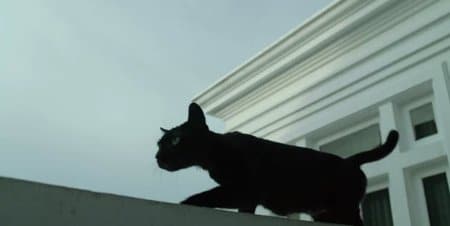
Narsha
is shown in juxtaposition with a cat walking around the elite's palace,
furthering the association with Kitten programming.
In an interview, the lyricist of the group Kim Eana explains Narsha’s role:
“Narsha represents the ‘sixth sense’ in itself, and
embodies the animalistic lyrics in the song (such as “The tips of my
sharp nails become embedded into your skin”). Since there is a recurring
‘jungle cat’ theme, Narsha was directed to act as wildly as possibly
for the video. The lights inside the cages are flashlights, a
symbol of constantly being watched and observed. What’s interesting
about her character is that although she looks afraid of it, she also
seems to enjoy being observed.”
Jea, representing sacrifice.
At first glance, the scene featuring Jea appears to be somewhat
poetic, with her floating in water and whatnot. On closer look, we
realize that she is tied up to the piece of wood and is left there to
die, in a matter vaguely similar to Christ tied up to the cross. We also
realize that this is taking place in the pool of the elite’s palace. In
other words, they placed her there to sacrifice her. Jea therefore represents the ritual sacrifices of the occult elite.
More than being simple employees, public figures that are part of the
Illuminati industry sometimes become unwilling parts of Illuminati
rituals. The lyricist of the group confirms that
“Jea represents the image of sacrifice. She’s tied to
tree branches, an idea derived from religion. Although the scene looks
beautiful from afar, the viewer is able to see that Jea is being
pressed down and chained.”
- Kim Eana
Ga-in, the traitor.
Ga-In’s character appears to have been beaten and humiliated by the
Absolute’s regime as a result of being a traitor. She is now tied to a
chair, between Masonic pillars and is being filmed by a camera. She is
the “example”, showing to others what happens to those who attempt to go
against the Absolute.
The Uprising
At one point, all of this singing and dancing apparently gets
everyone riled up and ready to start a revolution. The members of
B.E.G., who were shown above to be restrained and monitored, become
aggressive and rebellious (although they never truly free themselves).
The riot police feeds from this energy and become rebellious too. They
are shown questioning themselves as they remove their helmets to reveal
their faces. These soldiers are not simple pawns, they are young men
with emotions and stuff. They turn against their ruler and rush towards
him as water cannons protect the palace. At that point, the mask of the Absolute is shown thrown on the ground.
The
golden mask, representing the hidden, faceless elite is shown on the
ground, leading the viewers to think that the revolt was a success.
The scene then reverts to reality and shows again the riot police about to rush B.E.G.
There is no uprising. The riot police is right where is was.
The rebellion incited by the girls was one big fantasy dreamt up by
B.E.G. and the army. They are now back to the cold, hard reality: You
cannot fight the Absolute.
Meaning of the Video
Under the guise of entertainment, the video of Sixth Sense
gives its viewers a rather harsh lesson in power and politics. A basic
analysis of the story, answering simple questions such as “who won the
battle?” and “what’s the moral of the story?”, reveals that the elite
won and that resistance is useless. In fact, there never was any actual
resistance as B.E.G. were manipulated by the Absolute all along. The
uprising was nothing but a mere illusion, proving to the viewers that
they can be lead to believe anything they see. Presented as heroes of the people, B.E.G. is shown to be inciting a
riot and being agents of liberation. The only thing they however truly
accomplished is a mere distraction, a temporary escape to a world filled
with brave and determined people, ready to fight for freedom. This is
what mass media accomplishes on a daily basis: Putting in the spotlight
artists who are, in appearance, rebellious and uncompromising, yet
following their messages is exactly what the elite wants the masses to
do. In communication-theory terms, the viewers are subjected to a
Hegelian dialectic, where a thesis and anti-thesis are proposed, but
engaging in either one of them ultimately advances the agenda of the
elite. In other words, it is one big circular mind-screw. Here’s a
little description of how it works:
“For the elite of his day, and for the monetary elite
today, the Hegelian dialectic provides tools for the manipulation of
society. To move the public from point A to point B, one need only find a
spokesperson for a certain argument and position him or her as an
authority. That person represents Goalpost One. Another spokesperson is
positioned on the other side of the argument, to represent Goalpost Two. Argument A and B can then be used to manipulate a given social
discussion. If one wishes, for instance, to promote Idea C, one merely
needs to promote the arguments of Goalpost One (that tend to promote
Idea C) more effectively than the arguments of Goalpost Two. This forces
a slippage of Goalpost Two’s position. Thus both Goalpost One and
Goalpost Two advance downfield toward Idea C. Eventually, Goalpost Two
occupies Goalpost One’s original position. The “anti-C” argument now
occupies the pro-C position. In this manner whole social conversations
are shifted from, say, a debate over market freedom vs. socialism to a
debate about the degree of socialism that is desirable. The Hegelian dialectic is a powerful technique for influencing
the conversations of cultures and nations, especially if one already
controls (owns) much of the important media in which the arguments take
place. One can then, as the monetary elite characteristically do,
emphasize one argument at the expense of the other, effectively shifting
the positions of Goalposts One and Two.”
- Daily Bell, Hegelian Dialectic
Pop stars often play the role of “Goalpost Two” in entertainment
videos, but the blatant symbolism of these videos show that they are
truly working for the hidden rulers.
The
final scene from Beyonce's "Run the World (Girls)", saluting the riot
police. While, at first, Beyonce appears to be leading a resistance or a
liberation movement, this final scene tells the viewers that,
regardless what they just saw, she still obeys the orders of the powers
that be. Like Sixth Sense, this video also emphasizes the power of
sexuality to control the masses with lyrics such as "My persuasion can
build a nation/ Endless power, the love we can devour/ You'll do
anything for me."
Although the four members of B.E.G. were
shown to be somewhat rebellious, the core of their message was, at the
end, exactly what the elite wanted to communicate. The concept of Sixth Sense
appeals to the shutting down of intellectual and cognitive functions to
“surrender” to the mesmerizing effect of lust in mass media. It is
during this somewhat hypnotized and slightly aroused state that messages
can effectively reach the viewer’s brains with maximum effectiveness.
In Conclusion
By analyzing the political message of Sixth Sense, one
forgets that this video is primarily aimed at children and teenagers.
While listening to the music and admiring their idols’ dancing, the
viewers are exposed to a powerful lesson that sticks in the subconscious
mind: Resistance is futile. Even worse, resistance does not even exist
as those who appear to be resisting are just leading you towards the
elite’s goal. These kinds of propaganda videos existed under
dictatorships, but today they are passed around as “entertainment”. They
get massive airplay on MTV and millions of hits on YouTube. In reality,
nobody is forced to watch these videos, but they are nevertheless quite
popular. Is there a reason why people willingly subject themselves to
this kind of elite propaganda? Yes. These videos appeal to their Sixth Sense … and people like that.
A new contest involving Nestlé candy bars makes the concept of a highly monitored police state fun and exciting…for idiots. The ominously titled “We Will Find You” contest places a tracking chip inside the “winning” candy bar, allowing the Nestlé HQ to track winners via satellite and to dispatch a team to give them their prize. The TV ad states:
“The bar will be equipped with a GPS signaling device. When activated, it will beam a signal into space via satellite and will return to earth. This will alert a secret control room who will scramble a crack team of highly trained individuals. They will board a helicopter, find the special bar and give the winner 10,000£.”
Creepy Nestlé “We Will Find You” Contest Uses Chip to Track “Winner”
By VC | September 27th, 2012 | Category: Latest News | 74 comments A new contest involving Nestlé candy bars makes the concept of a highly monitored police state fun and exciting…for idiots. The ominously titled “We Will Find You” contest places a tracking chip inside the “winning” candy bar, allowing the Nestlé HQ to track winners via satellite and to dispatch a team to give them their prize. The TV ad states:
“The bar will be equipped with a GPS signaling device. When activated, it will beam a signal into space via satellite and will return to earth. This will alert a secret control room who will scramble a crack team of highly trained individuals. They will board a helicopter, find the special bar and give the winner 10,000£.”
Here’s the ad. So, to sum up, winners of the contest are tracked and found by a swap team who “arrest” them as if they were terrorists or enemies of the state. However, instead of beating the crap out of them and sending them to undisclosed jails, they give them 10,000£. You see how a police state is fun? Friendly agents jump out of helicopter and give you money! It’s perfect!…until they’ll use the same techniques to beat the crap out of dissidents and send them to undisclosed jails.
Like in everything else relating to her, Lady Gaga’s fragrance Fame
contains underlying occult elements that are only recognizable to those
who have some knowledge of it. While the advertisement surrounding the
perfume appears to acknowledge and even celebrate the dark, evil side of
fame, the composition of the perfume itself contains ingredients used
in ancient witchcraft and sex magick rituals. Here’s an interesting article by Felix London, an Australian fashion student, about Gaga’s fragrance and its occult elements.
A Brief Esoteric Interpretation Of ‘Lady Gaga Fame; The Fragrance’.
By Felix London
Throughout her meteoric rise to fame, Lady Gaga has established
herself as an undeniable phenomenon that has forced herself into the
universal consciousness of society. Her ingenious blend of contemporary
music, art, fashion and film has helped her emerge as the High Priestess
de jour of the pop culture collective for the new aeon. A 21st century
Pied Piper, leading the masses blindly to a fate preordained for them by
the elite.
It is no secret that a retrospect of her work shows a deliberate
inclusion of much occult and mind control symbolism and themes. Through
her music videos, songs, photo shoots and even costumes, it has become
evident that there is a definite underlying theme at work. Her latest foray into the fragrance industry, complete with super
stylized advertising is perhaps her most blatant offering yet. Her debut
fragrance, poised to become a world-wide #1 seller; “Fame” was
conceived by the Lady herself along with a new branch of her Haus of
Gaga creative team, titled “Haus Laboratories”.
At her own insistence the inky liquid is the world’s first black eau
de parfum, as in her own words she wanted it to be reflective of the
dark heart of fame. Avant Garde it may be, but on further research of
the fragrances ingredients, one may beg the question; is this perfume or
a potion?
Described on the packaging the fragrances ingredients read as
follows; tears of belladonna, crushed heart of tiger orchid with a black
veil of incense, pulverized apricot and the combinative essences of
saffron and honey drops. Belladonna, Italian for “Beautiful Woman” and
officially known as “Atropa Belladonna” is an extremely poisonous plant
that causes hallucinations, delirium and other psychological effects
like mind dissociation. Ancient folklore tells that Atropa Belladonna
was tended to by the devil himself.
The name Atropa is derived from the Ancient Greek Goddess Atrops. She
was said to be one of the three ‘fates’. In mythology she was
responsible for affecting the fate and destiny of the world by severing
the threads that connected a person to their bodies. This in turn
brought death.
Pre-dating the middle ages and throughout history the herb Atropa
Belladonna was a key ingredient in magick and was widely used by witches
in aid of flying, otherwise known as astrotravel or astroprojection. It
was believed that this herb had the ability to dissociate one’s mind
from its physical body, putting the user into a hypnotic trance,
enabling the witches to spiritually leave the body during the ritual
work.
The herb was also equated with aggressive female sexuality. It was
rubbed on the witches’ bodies to experience erotic sensations and
hallucinations before they would believe they participated in orgies
with spirits/demons on the sabbat. Even as late as the 1920’s the plant
was used by women to dilate the pupils, the purpose being to make them
appear more appealing and sexually alluring to men. Hence the term
Belladonna; beautiful woman. A mysterious choice of ingredient indeed,
but the recipe for this fragrance becomes more dark and ominous.
Whilst not noted on the packaging, the next key ingredient is a
synthetic pheromone based on the molecular structure of male semen.
Semen is filled with pheromones that transmit an increased sexual desire
to whoever smells it. Semen is also a very powerful ingredient in any
spell work or Magick along with blood, which is also a key component of
this fragrance. The mixing of blood and semen is straight out of
hermetic magick, founded by infamous occultist and self-proclaimed
‘Beast’ Aleister Crowley.
Combining the two for magical purposes forms part of the Gnostic
Mass, ritualized sex magick. Blood has a powerful spiritual truth
inherent within it. Blood binds the spiritual and physical together.
When used inside a ritual or sacrament, it will create either a contract
of covenant. The synthetic ingredient in this fragrance that adds the
blood was based on the exact molecular structure of a sample of Lady
Gagas own blood. Essentially she has shed her blood so the masses may
wear it. Perhaps ‘mother monster’ as she refers to herself is anointing
her ‘little monsters’ AKA fans through her perfume and in doing so
consecrating them to herself. The design of the bottle itself is also of importance. Visually it
appears as a black egg-shaped vessel with a gold lid from which long,
elegant, gold claws reach to clasp the bottle. The egg is one of the
most comprehensive symbols, equally suggestive in a spiritual,
physiological and cosmological sense. Among other things, it stands for
primordial chaos, the universal matrix, the great deep, the Virgin
Mother. As the symbol of generation, birth and rebirth, it is used not
only on account of the mystery of apparent self-generation, but from its
spheroidal shape, the sphere and circle both being symbols of
encompassing space.
The bottle is strangely reminiscent of the egg/vessel that Gaga
inserted herself into whilst being carried down the red carpet en route
to emerge on stage for her performance of ‘Born This Way’ at the 2011
Grammys. Gaga stated that she wanted to birth a new race. A race within a
race. The egg ritual dates back to Crowley who developed it to invoke
the ‘lam’ entity which is the entity or demon that has power over
speech. Adolf Hitler was himself a follower of Crowley’s doctrine and
utilized the egg ritual for his own desire to birth a perfect race. This leads to the film advertisement for the fragrance. It in itself
is artistically brilliant, if not little confronting or unsettling. The
fast paced, high fashion commercial utilizes numerous symbols throughout
its many scenes and boasts a soundtrack of one of her tracks ‘Scheiße’
the German word for ‘shit’ were she speaks in an almost chant like
German gibberish. The relevance of this song not only fits well with the
occult connection to Hitler, but also to the many de-humanizing mind
control techniques that were executed by German soldiers on Jewish
captives in concentration camps during the Holocaust. It should also be
noted that the word ‘Haus’ is German for ‘House’. Therefore ‘Haus
Laboratories’ further represents the German connection.
The visuals for the commercial further enforce the theme of mind
control and the occult. The creative aesthetic of Salvador Dali seems to
have played a major inspiration for the video, directed by fashion
photographer Steven Klein, who is known for his dark, provocative
fashion editorials that often utilize mind control and occult symbolism. The scenes that schizophrenically dart back and forth on the screen
employ classic examples of mind control symbolism. Dissociated vacant
eyes, blood curdling screams and tortured facial expressions from Gaga
herself. Stagnated and awkward cowering movements. The use of mirrors
and mirrored surfaces. The shattering glasses that represent a
fragmented mind. The clawed mirror or portal alludes to the ‘Through the
looking glass’ concept of Alice in Wonderland which was widely used
alongside The Wizard of Oz in Monarch Mind Control or MK Ultra carried
out by the CIA. These all equate to the themes of mind control.
There is also an undeniable element of occult ritual symbolism. The
portal itself may represent a portal to another dimension or a mode of
transport for the wearer to the ritual. The reflections of gaga in the
mirrors to create three images of herself, three being a very powerful
number to occultists. The scenes depicting a stylized, satanic like
ritual were gaga struts between men cloaked in red and near naked men,
faces distorted by black masking tape over one eye, kneeling before
them. Perhaps she is representing herself as the mediator between the
elite and the general public. The satanic and masonic themes are
evident. Also is the aggressive female sexuality and dominance over men,
which is depicted in many scenes and in the lyrics of the song used. In
various scenes Gaga is depicted as smearing a black substance across a
man’s face, laying on top of another man holding him down, a blown-up
vision of Gaga is seen reclining nude with only her modesty barely
covered by tiny men crawling on her body and even seen emerging from her
own lips as a crowned queen wielding a gun. Whilst being a rather brilliant concept it is hard to ignore the
deliberate themes in the commercial, along with the design of the bottle
and the molecular structure of the fragrance itself.
Is “Fame” by Lady
Gaga just a tongue in cheek publicity stunt or is it indeed a
representation of something more sinister? Has the Lady in fact gone gaga? Doubtful, she knows exactly what she is doing.
In this edition of Symbolic Pics: Police state
fashion, pop stars with weird t-shirts and ads that make you go
hmmm…(what you know about this C + C Music Factory reference??).
This
photoshoot “named State of Emergency” by photographer Steven Meisel
came out in 2006 (a few years before the creation of this site). It is
featured here because it eerily foreshadowed police state tactics that
appeared in the following years. And it makes it sexy. This pic
apparently predicted the the sexually demeaning TSA searches and
pat-downs that were instated around 2010.
Another
airport scene showing a mode forcibly undressed and searched at an
airport check up. Again, many cases of TSA agents requesting people to
undress and get patted down have appeared 3-4 years following this
photoshoot.
Allusions to police brutality at an airport, complete with batons and aggressive K9 unit…and look at that dress!
Agents with TSA badges violently apprehending a model. Is it foreshadowing the next step of “airport security”?
Other
pics in the shoot take place in the streets, where fashion models are
brutalized by police in riot gear. Its all about making police state
sexy.
Model laying on the ground with police foot on her throat…Police brutality is not glamorous.
I know I ask this often but…Is this fashion? Really?
As usual, a lot of one-eye signs popped out in mass media in August. Here’s Katy Perry with a mask hiding one eye.
Han Hyo Joo in September’s edition of Vogue Korea
On this single cover, Ayah Marar is hiding one eye and the name of the song is “Mind Controller”…Can’t really add more to that.
A gigantic hat hides one of Gwen Stefani’s eyes on the cover of Bazaar magazine.
This ad for Lady Gaga’s Little Monster mobile app reminds us that Gaga still is an Illuminati puppet.
Model
Coco Rocha doing the trifecta of Illuminati signs in the NY Times:
Self-mutilation, devil horns and one eye. Name of the article?
“Expanding Her Efforts to Be a Role Model”
Kreyshawn’s
album cover features a bunch of eyeballs and one-eyed creatures
observing her. A giant one-eyed thing is wrapped around her…is she under
its control? Also, there are pyramids in the background, making this
thing a big Illuminati tribute.
An interesting way of portraying Mitt Romney…
Ashley Benson is known for being an actress and for wearing shirts with inverted crosses on them.
In
last month’s Symbolic Pics, we saw Rihanna wearing a shirt saying
“Control Minds” in the shape of an inverted cross. This month, we have
Rihanna walking around with a shirt saying “Sex Kittens” – which is, as
we know, a type of Monarch programming. The shackled figures convey the
concept of mind control.
Illuminate your cigarette with this Illuminati lighter.
This
ad for OPI nail lacquer “celebrates the incredible life & legacy of
Whitney Houston”. If that’s the case, why does this thing appear to be
splashing blood everywhere? Is it subtly celebrating Houston’s
sacrifice? Let’s look at other ads by this same makeup company.
I guess we know who they’re rolling with…
This
graph made by MTV shows the world’s richest rock stars. Notice how a
bolt of lightning emerges from pyramid of artists to another pyramid
with an all-seeing eye at the bottom. Is the image hinting at who or
what made these artists as rich as they are?

















 Posts
Posts


